When Customers Send Sensitive Data in Chat: A Practical Triage Playbook for Support Teams
A repeatable support workflow for containing unexpected sensitive data, protecting the customer, escalating correctly, and preventing the next avoidable disclosure.
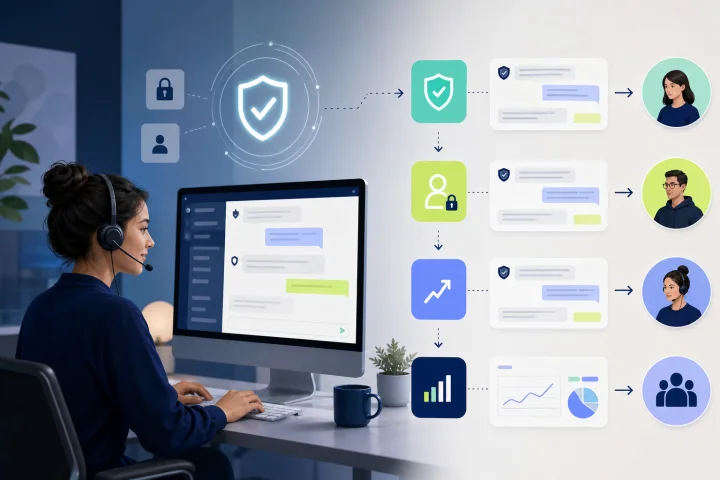
Why this is a support-operations problem
A customer may paste a card number, password, identity-document image, medical detail, or account-recovery code into a conversation while trying to solve an urgent problem. The immediate concern is not whether the agent made a mistake. It is whether the team can respond consistently before the disclosure expands through replies, notes, exports, assignments, or informal internal messages.
Treat an unexpected sensitive-data message as an incident candidate. That does not mean every message is a confirmed breach or requires the same response. It means the event needs a defined containment and escalation workflow, rather than an improvised decision by a single agent.
The durable objective is simple: stop further disclosure, protect the customer and relevant account, preserve only the operational context the right owners need, and improve the interaction that made disclosure likely.
- Frontline agents contain, reassure, redirect, and escalate.
- Privacy, security, legal, and accountable business owners decide matters such as investigation scope, deletion handling, notification, reporting, and remediation under organizational policy.
- Supervisors ensure the case is routed, access is limited, and customer follow-up has an owner.
- Quality teams turn recurring incidents into conversation and workflow improvements.

Define sensitive data for chat triage before an incident happens
Use a deliberately broad triage definition. Information may be sensitive because it directly identifies a person, or because it can be linked to them in context. The classification is for fast operational routing; it does not replace the organization’s formal data-classification policy or legal assessment.
Build agent guidance around recognizable examples. Agents should not have to debate terminology while a customer is waiting. A short taxonomy, supported by examples and escalation rules, makes the first-minute response reliable.
- Payment information: card numbers, card security codes, bank-account details, payment credentials, and financial transaction details.
- Credentials and access secrets: passwords, one-time codes, recovery codes, security answers, private keys, or authentication links.
- Identity evidence: passport or driver-license numbers, Social Security numbers, national identifiers, biometric data, and images of identity documents.
- Health-related information: medical history, treatment information, patient identifiers, or documents containing individually identifiable health information.
- Account-risk data: a report that an account was taken over, an unfamiliar login, a changed contact detail, or an exposed credential.
- Lower-risk personal data: a name, address, phone number, or order reference may still need careful handling, particularly when combined with other details.

The first-minute response: contain without repeating
The agent’s first reply should acknowledge the customer, ask them not to send more sensitive information in chat, and point them to an approved next step. Do not quote, paraphrase, verify, or repeat the sensitive value. Repetition can create another unnecessary copy of the information and can invite further disclosure.
For payment information, do not assume that every chat channel is automatically prohibited from receiving cardholder data. PCI DSS does not itself prohibit messaging technologies from requesting or receiving a primary account number, but the channel and related systems must meet applicable requirements and may be in scope. Where the organization does not intend the channel to handle card data, agents should use the approved payment route and follow the established accidental-receipt process.
Keep the response short and factual. Avoid promises that the information has been deleted, that no one can access it, or that the customer has no risk unless an authorized owner has confirmed those facts.
- Acknowledge: “Thanks for letting us know. I can help with this.”
- Stop further disclosure: “For your protection, please do not send any more card, password, code, or identity-document details in this chat.”
- Redirect: “Please use our approved payment or account-recovery process instead.”
- Protect: for a possible credential or takeover issue, start the approved account-protection escalation immediately.
- Escalate: apply the incident route without copying the sensitive content into a new place.
Containment rules: what agents should and should not do
Containment means limiting unnecessary processing and visibility. An agent should follow the approved workflow, not create a second sensitive-data repository while trying to be helpful. The organization’s privacy and security owners should define the exact handling steps for each channel and incident type.
Use operational references that reveal the minimum necessary context. For example, an internal escalation can say “possible payment data sent in chat” or “suspected credential exposure,” plus the approved case reference and time. It does not need to reproduce the value, attach a screenshot, or include a copied transcript unless an authorized process specifically requires it.
- Do not paste sensitive content into internal notes, tags, templates, emails, team chat, ticket titles, or handover messages.
- Do not use a tag that contains the secret or document number. Use a neutral, approved incident label instead.
- Do not download, forward, screenshot, or export the conversation unless the approved incident process requires it and the recipient is authorized.
- Do not ask the customer to resend the information in another free-form channel.
- Do not manually delete, alter, or promise deletion of records outside the documented process.
- Do record the minimum operational facts required by policy: incident category, time observed, conversation or case reference, actions taken, and escalation destination.
Use a decision tree for immediate risk
A workable decision tree separates urgent customer protection from later review. Frontline agents do not need to determine legal obligations or technical scope. They need to identify the risk category, take the prescribed immediate action, and transfer ownership to the right role.
Set your own service-level targets and contact methods in the incident plan. The important design decision is that suspected account compromise and exposed credentials have a path that is visibly faster than a routine privacy question.
- If credentials, a one-time code, or a recovery code were exposed: instruct the customer not to send more, trigger the account-security path, and use the organization’s approved account-protection steps. Escalate as urgent.
- If payment-card data was sent: stop further disclosure, direct the customer to the approved payment method, and route the event through the documented card-data handling process.
- If an identity document or high-risk identifier was sent: contain, classify as identity-data exposure, and route to the designated privacy or security owner.
- If the customer reports suspected account takeover: treat it as an account-security event even if no secret is visible in the chat. Route to the account-protection owner immediately.
- If lower-risk personal data was sent: avoid amplification, continue only with information necessary for the support purpose, and escalate when the context, volume, or customer risk meets your policy threshold.
- If the agent is unsure: choose the safer route—stop collection and ask a supervisor or designated incident owner to classify it.
Design an escalation path with named owners
A policy that says “escalate to the appropriate team” is not an escalation path. Name the roles, backup roles, channels, required minimum context, and handoff expectations. The plan should also distinguish urgent account protection from privacy review and from legal or communications decisions.
NIST guidance emphasizes defined reportable events, information-sharing expectations, and assigned responsibilities. In practice, a small organization may assign several functions to one trained person. What matters is that the responsibility is explicit and reachable when the incident occurs.
- Frontline support owner: sends the containment response, stops further collection, applies the approved neutral classification, and opens the escalation.
- Supervisor or duty manager: confirms correct routing, maintains customer-service continuity, and resolves uncertainty when the frontline agent cannot classify the case.
- Security or account-protection owner: handles suspected credential exposure, account takeover, and technical containment under the organization’s response process.
- Privacy owner or data-protection lead: assesses personal-data handling, access, retention, and required internal coordination.
- Legal and communications stakeholders: decide notification, external reporting, customer remediation, and public communications when applicable under policy and advice.
- Business or data owner: confirms service context, customer impact, and corrective changes to the underlying process.
Respect channel and platform boundaries
A chat workflow is a chain of systems, policies, and people. A messaging provider may have its own retention, delivery, encryption, export, and account controls. Your support team controls its own instructions, agent behavior, routing, access model, approved collection methods, and escalation procedures. Do not confuse one with the other.
Before making a channel-specific decision, verify the current official documentation for the channel, connected systems, and your organization’s approved use case. In particular, do not infer that a platform capability changes the organization’s obligations for payment data, health-related information, identity documents, or security incidents.
webchat.vip supports WebChat and WhatsApp in its shared inbox. Each WebChat channel has an installable, customizable, multilingual widget. Operational controls within the inbox can support disciplined handling, but they do not replace an organization’s privacy, security, retention, legal, or payment-card compliance program.
- Confirm the approved channel for payments, identity verification, and account recovery before publishing agent guidance.
- Document which team owns channel configuration and which team owns incident response.
- Do not make retention or deletion claims to customers based on assumptions about any provider.
- Recheck official channel documentation when changing a workflow or adding an integration.
- Keep customer-facing guidance consistent across WebChat, WhatsApp, help-center content, and agent templates.
Frequently asked questions
Should an agent ask a customer to delete the message containing sensitive data?
An agent can ask the customer not to send more sensitive information, but should not improvise deletion instructions or promise a deletion outcome. Follow the organization’s documented channel, retention, and incident process, then escalate the case to the designated owner.
What should an agent do if a customer shares a password or one-time code?
Do not repeat or verify the secret in chat. Ask the customer not to send more, trigger the urgent account-security or account-protection path, and direct the customer to the approved recovery process. A suspected account compromise should not wait for ordinary queue handling.
Can a support team collect card details in chat?
Do not assume either that chat is always prohibited or that it is automatically acceptable. PCI DSS does not itself prohibit messaging technologies for cardholder data, but relevant channels and systems must meet applicable requirements and can be in scope. Use the organization’s approved payment method and documented card-data process.
What is the minimum an internal incident note should include?
Use only the facts needed to route and manage the incident: a neutral incident category, case or conversation reference, time observed, actions taken, and assigned owner. Do not copy the sensitive value, attach unnecessary screenshots, or put it in a title, tag, or transfer message.
How can webchat.vip help reduce repeat disclosures?
Teams can use WebChat widget customization, reusable templates, routing, departments, and automated flows to set clear expectations and direct customers to an approved human or process. Automated flows can send messages and files, collect validated responses, branch, transfer, and hand off to people; teams should design those flows to request only information necessary for a defined purpose.
Who decides whether customers or authorities must be notified?
That decision belongs to the organization’s designated privacy, security, legal, and business owners under applicable policy and advice. The frontline support role is to contain the disclosure, protect the customer where the approved process requires it, and escalate promptly.
Sources and further reading
Primary and authoritative references used to verify the factual foundation of this guide.
- NIST SP 800-122: Guide to Protecting the Confidentiality of Personally Identifiable Information (PII) — National Institute of Standards and Technology
- NIST SP 800-61 Rev. 3: Incident Response Recommendations and Considerations for Cybersecurity Risk Management — National Institute of Standards and Technology
- NIST SP 800-171 Rev. 3: Protecting Controlled Unclassified Information in Nonfederal Systems and Organizations — National Institute of Standards and Technology
- PCI SSC FAQ 1157: Accidental receipt of cardholder data through an unintended channel — PCI Security Standards Council
- PCI SSC FAQ 1310: Cardholder data and end-user messaging technologies — PCI Security Standards Council
- Basic Principles — European Data Protection Board
- Data Protection Basics for Small Business — European Data Protection Board
- Guidelines 4/2019 on Article 25 Data Protection by Design and by Default — European Data Protection Board
- The Security Rule — U.S. Department of Health and Human Services
- Guidance Regarding Methods for De-identification of Protected Health Information — U.S. Department of Health and Human Services