Identity Verification in Customer Support Chat: A Risk-Based Design Guide
A practical framework for deciding what support teams need to establish in chat, how much evidence to request, and when to move a case to a safer human-led path.
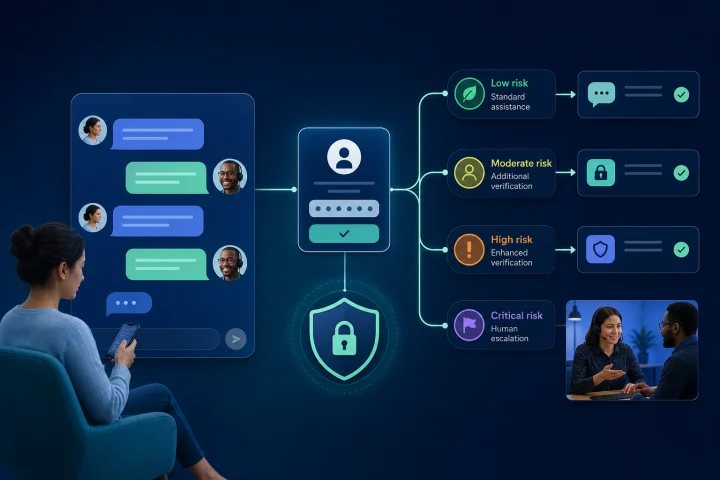
Why identity verification in messaging needs a risk-based approach
Customer support identity verification is not one universal question with one universal answer. A customer asking for opening hours creates a very different risk from someone requesting an address change, a disclosure of account history, or a consequential account action.
A chat channel can make it easy to ask questions and collect replies. That convenience is not evidence that the conversation holder should receive protected information or make a sensitive change. Set the assurance required by the potential harm if the decision is wrong: privacy exposure, unauthorized modification, financial loss, loss of service, or harm to a customer.
Use the least intrusive route that safely supports the action. Low-risk requests should remain easy. Higher-risk requests should move to a stronger authenticated route or a documented human-led recovery process. Do not compensate for an unclear risk model by routinely collecting more personal data in chat.
- Start with the requested outcome, not with a standard list of identity questions.
- Increase assurance as the possible impact of an incorrect decision increases.
- Separate normal support handling from account recovery and suspected-impersonation handling.
- Treat data minimization, accessibility and escalation as requirements of the workflow, not optional refinements.

Separate three decisions that teams often call “verification”
The word “verification” often conceals three distinct decisions. Combining them leads to unnecessary data collection at one end and dangerous overconfidence at the other.
Identity proofing asks, “Who is this person?” It involves collecting, validating and verifying information to establish assurance in a claimed identity. This is not needed for every support conversation.
Authentication asks, “Can this person demonstrate control of an account-bound authenticator?” It can establish access to an account, but it does not prove every real-world attribute, relationship or permission the person claims.
Authorization asks, “May this authenticated person perform this particular action?” An authenticated account holder may still lack permission to approve a refund, alter another user’s details, act for an organization, or perform a high-impact action. Authorization should be checked for each protected request, with a deny-by-default mindset.
- Identity proofing: establish assurance in a claimed identity when the use case requires it.
- Authentication: establish control of an account-bound authenticator.
- Authorization: confirm the permission for the requested action, account, object and context.
- Case handling: gather only the information needed to understand and resolve the issue; this is not automatically identity evidence.

Classify requests by potential harm before designing prompts
A simple request classification gives agents and automation a consistent basis for routing. It also prevents a low-risk customer from being subjected to a high-friction challenge that adds little protection.
Define categories around the outcomes your team can disclose or perform, then document examples and exceptions. The categories below are a starting model; the right thresholds depend on your service, customer population and applicable obligations.
- General information: public policies, product guidance, service hours and non-account-specific troubleshooting. No account verification should be required merely to answer these questions.
- Account-specific information: balances, order details, private messages, account history, contact details or service status. Use an authenticated account route before disclosure.
- Account changes: changes to contact details, preferences, access settings, delivery details or linked users. Require a stronger route and check whether the authenticated party is authorized for that specific change.
- High-impact actions: account recovery, security-setting changes, payment-related actions, closure, major service changes or actions with serious customer consequences. Use a deliberately designed high-assurance process and trained human review where ambiguity remains.
Apply data minimization to every chat step
Before writing a prompt, state its precise purpose: what decision will this answer enable, and what is the minimum information needed to make that decision? Data minimization requires information to be adequate and relevant for the stated purpose, but limited to what is necessary.
Do not ask a customer to prove more than the requested action requires. For example, an agent may need non-sensitive details to locate a case, while the system should require an authenticated account route before revealing account-specific information. A request to send a document, a full date of birth, or other sensitive data should never be a default substitute for a designed verification path.
Make prohibited inputs visible in the journey. Customers should be told not to send passwords, account-recovery codes or other reusable secrets in a support conversation. If they send sensitive information anyway, follow a documented containment procedure rather than repeating or copying it into additional records.
- For each field, record its purpose, whether it is essential, who can view it and how long it is retained.
- Use validated responses only for information that is genuinely necessary to route or handle the case.
- Avoid collecting credentials, recovery codes and other reusable secrets in chat.
- Do not treat a conversational answer to personal questions as a universal identity check.
- Review templates and agent macros for requests that collect information “just in case.”
Choose a verification method that fits the action
For protected account information and changes, the safer pattern is to direct the customer to an established authenticated account process rather than asking them to establish identity through chat messages. The chat can explain why the step is needed and remain available to help with non-sensitive troubleshooting.
For loss of access, use a documented recovery route based on risk analysis. Recovery may involve an approved account-recovery process, repeated identity proofing, a recovery contact or an application-specific agent interaction. The key operational rule is not to lower the normal threshold simply because the customer is unable to pass it in chat.
Where recovery succeeds, notify the subscriber or appropriate designee after the recovery event so potentially fraudulent recovery can be detected. Encourage customers, where your account design supports it, to maintain more than one independent way to authenticate to reduce reliance on exceptional recovery journeys.
- Use public chat information for public questions.
- Use an authenticated account route for account-specific disclosure.
- Check account role, relationship and permission for changes requested by an authenticated user.
- Use a separate, documented high-impact or recovery process for exceptional cases.
- Do not ask for a password or recovery code as proof in a chat message.
Build a safe, understandable messaging flow
A secure flow should also be understandable. Explain what the team needs to do, why the step is necessary, what the customer should not send, and what will happen if they cannot complete it. Clear explanation reduces accidental oversharing and makes a refusal feel like a protective control rather than a dead end.
A practical pattern is: classify the request, explain the purpose, offer the appropriate route, validate the resulting status, make the authorized decision, and record the minimum operational context. Avoid revealing protected details while a customer is still attempting verification.
Provide an accessible alternative. Authentication should not make a cognitive-function test the only route available. Help and recovery options should be consistently available across WebChat journeys so customers can find them when an attempt fails.
- Use plain language: “To protect your account, we need you to use the secure account sign-in route before we can discuss this detail.”
- State a clear prohibition: “Do not send your password or any account-recovery code here.”
- Explain the fallback: “If you cannot sign in, choose account access help or ask for a support specialist.”
- Keep the same help location and wording across entry points where possible.
- Confirm only what is safe to confirm; do not expose account data while the decision remains unresolved.
Set channel-specific expectations without confusing channel behavior and team controls
WebChat and WhatsApp are messaging entry points, not a complete authorization policy. Your organization remains responsible for defining which requests can be handled in each channel, what evidence is accepted, how sensitive cases are transferred, and what staff may disclose or change.
For WhatsApp guidance, remind customers not to share credentials or sensitive personal information in response to unexpected requests. This is customer safety guidance, not a claim that a messaging conversation alone proves identity or authority.
In webchat.vip, a shared inbox can help teams organize WebChat and WhatsApp conversations across operators, departments, routing, schedules, service levels, templates and tags. Configure these operational tools around your policy; do not let a routing label or a channel identifier stand in for authentication or authorization.
Each WebChat channel can use an installable, customizable and multilingual widget. Keep the safety notice, accessible help route and escalation wording consistent across widget languages, then validate translations with the same care as the primary journey.
- Define channel-appropriate limits for disclosures and changes.
- Keep provider-controlled channel behavior separate from your own support procedures and account controls.
- Use approved templates for no-secrets warnings and secure-route explanations.
- Ensure the escalation option is easy to locate in every supported language.
- Train agents never to improvise a weaker identity challenge for convenience.
Frequently asked questions
What is customer support identity verification?
It is the set of controls a support team uses to establish the assurance needed before handling a request. In practice, teams should distinguish identity proofing, authentication of account access and authorization for a specific action rather than treating all three as the same check.
Should support agents ask customers to send passwords or recovery codes in chat?
No. Passwords and recovery codes are reusable secrets and should not be requested in a support conversation. Direct customers to the established secure account or recovery route instead.
Is a WhatsApp message from a known number enough to authorize an account change?
No. Possession of a messaging conversation or phone number should not be equated with authority for a sensitive request. Use the documented authenticated and authorized process for the particular change.
What should happen when a customer cannot pass verification?
Do not weaken the normal verification threshold in chat. Provide the planned recovery or escalation route, explain the next step clearly, and transfer ambiguous or high-impact cases to trained people.
How can automation help with identity-verification journeys?
Automation can collect non-sensitive case details, present safety guidance, classify request risk, validate suitable responses and transfer cases. It should not make unsupported identity or authorization judgments, and sensitive or ambiguous cases need a human escalation route.
What should support teams log about a verification decision?
Log the minimum operational context needed to investigate and audit the decision, such as request category, route used, outcome, escalation and authorized action. Avoid unnecessarily recording sensitive information, secrets or excessive personal data.
Sources and further reading
Primary and authoritative references used to verify the factual foundation of this guide.
- NIST SP 800-63-4: Digital Identity Guidelines — National Institute of Standards and Technology
- NIST SP 800-63A-4: Identity Proofing Overview — National Institute of Standards and Technology
- NIST SP 800-63B-4: Authentication and Authenticator Management — National Institute of Standards and Technology
- Authorization Cheat Sheet — OWASP Foundation
- Authentication Cheat Sheet — OWASP Foundation
- Regulation (EU) 2016/679, Article 25: Data Protection by Design and by Default — EUR-Lex / European Union
- Data Minimisation Guidance — Information Commissioner's Office
- Web Content Accessibility Guidelines (WCAG) 2.2 — W3C Web Accessibility Initiative
- Accessible Authentication (Minimum): Understanding Success Criterion 3.3.8 — W3C Web Accessibility Initiative
- Message Privately and Safely — WhatsApp Help Center