Change Customer-Service Automation Without Losing Handoffs
A practical change-control method for updating customer-service automation while keeping routes, error handling and human support dependable.
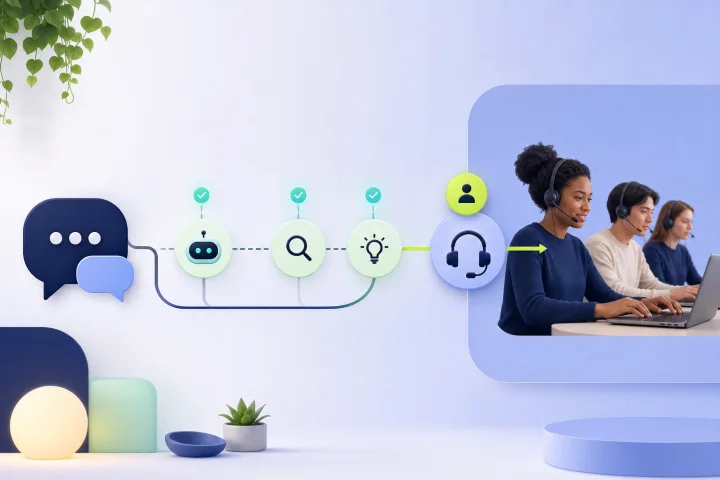
Why a small flow edit can create a large customer-service failure
A changed sentence, validation rule or routing condition can affect far more than the screen being edited. It can send customers to the wrong department, repeat a question they have already answered, trap an unclear reply in a loop, or remove the route to a person at the point of greatest need.
Treat customer service automation change management as operational change control, not copy editing. NIST describes disciplined change control as proposing, justifying, implementing, testing, reviewing and recording the disposition of changes. This approach is proportionate even for small support-flow changes because the customer journey crosses content, data collection, routing, staffing and follow-up.
In webchat.vip, teams can organize operators by department, language, channel access and concurrent-conversation limits. Routing can use department, operator, keyword and priority while considering availability and capacity. A flow change therefore needs to be reviewed alongside the people and schedules that must receive its escalations.
- Do not publish an edit because it looks correct in isolation.
- Assume that every changed branch has a customer path, an operational owner and a possible failure mode.
- Use a higher level of review when a change affects sensitive requests, eligibility decisions, payments, identity-related information, urgent matters or the ability to reach a person.

Review the five flow elements before any change
Review a flow as a connected system of message, input, branch, routing and handoff. The wording may be accurate while the input instruction is unclear; the branch may work for an expected answer while a route fails after a misspelling; the routing rule may work during staffed hours but not when no eligible operator is available.
For each edited element, identify what enters the step, what the customer sees, what outcome follows, and who becomes accountable if it fails. Keep the design simple enough that a reviewer can explain the journey without relying on assumptions.
- Message: Is the purpose clear, concise and appropriate for the customer’s situation? Does it state what happens next?
- Input: Are labels and instructions present? WCAG 2.2 requires labels or instructions when user input is required.
- Branch: What happens for valid, invalid, blank, unexpected and ambiguous answers?
- Routing: Which department, operator, language or priority rule applies, and what happens if capacity or availability changes?
- Handoff: Can the customer ask for a person, and is there a defined destination and fallback?

Classify changes by customer and operational risk
Risk classification determines how much testing and approval a change needs. A low-risk spelling correction in a non-decisive message is different from a new branch that controls whether an urgent request reaches a specialist. Classification should consider both the likely harm to the customer and the difficulty of detecting or reversing a bad release.
Use the highest applicable classification. If the team cannot agree on a change’s impact, treat it as at least medium risk and involve the service owner.
- Low risk: clarity or formatting changes that do not alter collected data, branching, routing, handoff or customer commitments. Peer review and focused verification may be sufficient.
- Medium risk: a changed validation rule, template, tag, department route, schedule-dependent route or file. Require a documented test set, owner approval and a rollback plan.
- High risk: changes that can prevent escalation, alter treatment of sensitive or urgent cases, create a customer commitment, or materially change who receives a case. Require operations approval, representative end-to-end testing, planned monitoring and an explicit release window.
- Stop and escalate: suspend publication if no accountable handoff owner exists, the fallback is unknown, or the team cannot describe what happens outside staffed coverage.
Create a lightweight flow-change record
A short record prevents knowledge from living only in an editor’s memory. It also makes rollback faster when a live issue appears. NIST change-control guidance includes recording decisions, implementing approved changes, retaining controlled-change records and reviewing change-control activity.
Keep the record where the automation owner, support lead and reviewers can find it. Do not include customer secrets, credentials or unnecessary personal data in the record.
- Change ID, date, requester and accountable owner.
- Purpose and expected customer outcome.
- Exact elements changed, affected channels and affected languages.
- Entry points, branches, destinations, tags, templates, files and schedules that may be affected.
- Risk level, reviewer and approval decision.
- Test cases, test results and release time.
- Rollback action, responsible person and the prior known-good configuration or wording.
- Post-release review date and the metrics or conversation samples to inspect.
Map the full journey, not only the intended path
The happy path is necessary but insufficient. Customers may send a partial answer, a different language, several questions at once, an attachment, an emoji, a repeated message or no reply at all. They may also return after an earlier interaction with relevant history already available to the support team.
Map every entry and exit. Include repeat contacts, transfer attempts and inactivity outcomes. webchat.vip offers configurable inactivity actions that can notify, unassign, archive, close or send transcripts; check that these actions do not end a conversation that still needs human attention.
Use customer context carefully. Customer history, sessions, source and tags can help an operator understand the interaction, but automated treatment should not depend on hidden assumptions the customer cannot correct.
- Expected answer and a valid completion.
- Blank, malformed, incomplete and ambiguous input.
- Input that fails validation, including the customer-facing correction message.
- A request to speak to a person at every relevant step.
- A language mismatch or unsupported-language response.
- No reply and return after inactivity.
- A repeat contact that enters the same flow again.
- No available operator, closed hours, full capacity or a failed transfer.
Protect the human handoff as a designed capability
Human escalation must be more than a vague promise. Use direct escape language such as “Reply ‘agent’ to speak with our support team” where it is appropriate to the flow, and make sure the request has a real destination. Avoid language that implies immediate help when the service is unavailable.
Define the destination department or operator group, eligibility rules, ownership after transfer and the response expectation. Use schedules with weekly windows and date exceptions to reflect actual coverage. When no one is available, give a truthful next step: collect the minimum information needed for follow-up, state the relevant service window if your policy permits, or direct the customer to an approved urgent-support route.
Do not rely on automation to make high-stakes judgment calls. A person should review cases involving uncertainty, distress, complaints, exceptions, safety concerns or requests that the automated path cannot resolve.
- Escape wording is visible, plain-language and available before the customer becomes stuck.
- The route has a named department or accountable queue owner.
- Coverage, language capability and capacity have been checked.
- The unavailable-team fallback is tested and does not silently close or abandon the case.
- Transferred conversations retain enough context for the receiving operator to avoid asking the customer to start over.
- A human escalation contact is documented for failures that the support team cannot resolve.
Test before publishing
Test in a separate environment before operational release whenever possible. NIST specifically calls for analyzing changes in a separate test environment before implementation in an operational environment, including for weaknesses and incompatibilities. If a separate environment is not available, reduce exposure: use a narrowly scoped release, schedule it when owners are available and be ready to restore the prior configuration immediately.
Test with realistic customer wording rather than only the exact choices used to build the flow. Record the observed outcome, including the visible message, applied route and final owner. Do not use real customer data in test conversations unless your organization has an approved basis and safeguards for doing so.
Accessibility checks are functional checks. When validation detects an error, WCAG 2.2 requires the item in error to be identified and the error described in text. Verify that labels and instructions remain understandable in every supported language.
- Complete each intended path with valid responses.
- Enter invalid, blank, misspelled and ambiguous responses.
- Request a human at the beginning, middle and end of the flow.
- Check validation messages for clear text identification and explanation of the error.
- Test language variants and fallback wording.
- Check that attached files, where used, are correct, current and appropriate for the branch.
- Test operator unavailable, capacity-limited and out-of-schedule conditions.
- Check keyboard-operable interaction and understandable instructions in the customer-facing widget.
Release in stages and prepare rollback
A staged release limits the number of customers exposed while the team verifies real behavior. Start with the smallest practical audience, entry point, language or time window. Assign a release owner who can observe the outcome and a rollback owner who can act without waiting for a long approval chain.
Define objective stop conditions before release. Examples include a transfer route failing, a rise in unhandled conversations, a branch looping, customers repeatedly requesting an agent, or a customer-facing error that exposes information it should not. The correct response is to restore the known-good version, protect active customers and investigate before retrying.
Channel delivery and policy behavior are not controlled solely by webchat.vip. WebChat and WhatsApp are the currently implemented channels, and WhatsApp connection uses Meta Embedded Signup. The messaging-channel provider can control delivery, template or policy requirements and other channel behavior. Test the journey in the actual channel and keep provider-controlled failures distinct from webchat.vip configuration issues.
- Choose a release window with the automation owner and receiving support team available.
- Confirm the prior configuration can be restored and that active transferred cases will remain owned.
- Publish only the approved scope; avoid bundling unrelated edits.
- Watch the first live cases immediately after release.
- Rollback on a defined stop condition rather than trying to repair a live broken route ad hoc.
- Document what happened, including the time, affected path, observed behavior and recovery action.
Frequently asked questions
What is customer service automation change management?
It is the disciplined process of assessing, approving, testing, releasing, monitoring and, when necessary, reversing changes to customer-service automation. Its purpose is to prevent an apparently small edit from breaking routing, validation, customer expectations or access to human help.
When should an automation change require human approval?
Require human approval for changes that alter routing, validation, schedules, escalation, customer commitments, sensitive-case handling or the ability to reach a person. If the team cannot explain the fallback when a route fails or no operator is available, pause the release and escalate to the service owner.
How should a customer ask for a human agent?
Provide direct, understandable escape language at relevant points in the journey and test it. The request should transfer to a named team or accountable queue, with a truthful fallback for unavailable hours or capacity limits.
What should be monitored after an automation release?
Review conversation logs, tags, transfer patterns, ratings, response and resolution objectives, delivery and reading information, and conversation trends. In webchat.vip, operational analytics and exportable reports can support this review. Look for loops, repeated contacts, failed transfers, unexpected closures and increased agent requests.
Who controls failures caused by a messaging channel?
Separate the automation configuration from messaging-channel behavior. webchat.vip controls its configured inbox, routing, schedules, tags and available automation capabilities. A channel provider may control delivery, policy requirements, templates or connection behavior. Record the observed evidence and escalate to the appropriate owner rather than assuming one team controls the entire journey.
Sources and further reading
Primary and authoritative references used to verify the factual foundation of this guide.
- webchat.vip product overview — webchat.vip
- NIST SP 800-53 Rev. 5.1 — Configuration Management controls — National Institute of Standards and Technology
- Web Content Accessibility Guidelines (WCAG) 2.2 — W3C
- OWASP Application Security Verification Standard, version 5.0 — Security Logging and Error Handling — OWASP Foundation
- OWASP Application Security Verification Standard project — OWASP Foundation