How to Identify Duplicate Customer Contacts Without Merging the Wrong Support Cases
A risk-based workflow for recognizing related customer conversations while protecting case continuity, privacy and accurate ownership.
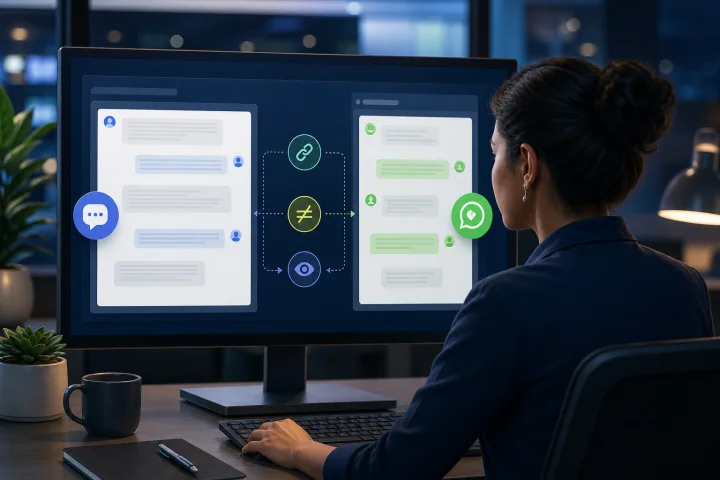
Duplicate contacts are a continuity and privacy decision
To identify duplicate customer contacts safely, distinguish a related conversation from a proven identity match. The same person may contact support twice about one unresolved problem, but they may also return with a new issue. A shared phone, family email address, workplace account, recycled phone number or common name can make two different people look alike.
Identity resolution can help distinguish a person within a defined context, but it is not equivalent to identity proofing or authentication. A contact attribute such as a name, email address or phone number is useful matching evidence; it does not by itself prove that the current requester controls an account or may receive protected case details.
Treat the decision as a three-way routing choice, not an inbox-cleanup task: link related conversations, keep them separate, or send the possible match to review. The safer default for uncertainty is to preserve separate records while a trained person assesses the situation.
- Legitimate repeat contact: the customer is chasing an existing unresolved request.
- Separate issue: the same customer has a different order, product, incident or question.
- Shared access: a household, team or business account is used by more than one person.
- Ambiguous identity: similar names or reused contact details create a plausible but unconfirmed match.

Why harmful merges cost more than extra threads
An unnecessary extra thread can cause repeated questions and fragmented ownership. A wrong merge can be worse: an operator may expose case context to the wrong person, close an active issue, overwrite accountability, or report two customers as one. Conflicting replies also become more likely when separate operators unknowingly work related conversations.
Use the shared inbox as an operational record rather than a place to erase ambiguity. webchat.vip provides a shared inbox for WebChat and WhatsApp conversations, plus operator and department organization, routing, schedules, service levels, templates and tags. Those controls can support a documented review process, but they do not establish identity by themselves.
Do not delete or collapse the original conversation merely to make the inbox look clean. Preserve channel context, timestamps, participants, prior commitments and the original case purpose. If your procedure permits linking, record the relationship and the reason; retain each source record according to the organization’s retention rules.
- Failure mode: an operator marks two same-name customers as one and sends order information to the wrong person.
- Failure mode: a repeat WhatsApp message is treated as a new case, so two agents give incompatible updates.
- Failure mode: a workplace contact is merged with the employee’s personal request, mixing distinct roles and permissions.
- Failure mode: a closed case is reopened or a live case is closed because a related conversation was mistaken for the same request.

Set a matching hierarchy and prohibit assumption-led matches
Write a hierarchy that tells operators which evidence can suggest a relationship and which evidence is required before restricted information is discussed. Start with stable identifiers already held in the relevant service context, then compare case-specific context. Use the minimum identity evidence and attributes needed for the purpose; collecting more personal data than necessary increases privacy risk without necessarily improving the decision.
A practical hierarchy is: verified account or case reference under your approved verification process; authenticated account context where applicable; a prior conversation reference; then corroborating context such as the same product, incident, date, non-sensitive transaction reference or stated objective. Name similarity, device similarity, writing style, location guesses and a newly supplied email or phone number should never be enough to confirm a match.
Keep identity separate from role. One person may legitimately contact support as an individual and as a representative of a business. A match on the person does not automatically mean the cases, permissions or disclosure scope should be combined.
- High-confidence evidence: an approved, validated case reference combined with appropriate verification for the requested action.
- Contextual evidence: same issue timeline, product or service, and a consistent non-sensitive description.
- Weak evidence: same display name, approximate location, similar wording or a shared contact attribute.
- Disqualifying signal: incompatible case purpose, different authorized role, conflicting customer details, or any indication that the account may be shared or compromised.
Apply the three-outcome decision rule
Link conversations only when the evidence supports a shared case purpose and the proposed link will not expand access to protected information. Keep them separate when the issues, roles, authorization or ownership differ—even if they appear to involve the same individual. Send the record for review when evidence is incomplete, conflicting, or higher risk.
A link is a relationship between records, not a license to disclose everything from one record in another channel. Before exposing account or case details, use the organization’s appropriate verification process. For sensitive account access, authentication is a separate control from contact matching.
Define who can make each decision. Frontline operators can usually identify an obvious repeat message and apply a neutral related-case tag. A designated lead, privacy-trained reviewer or account-security team should decide uncertain matches, cross-role cases, suspected takeover or recovery-related requests. Escalate immediately if the requester asks to change contact details, access restricted information, close a case for another person, or redirect a refund, delivery or account action.
- Link: same approved reference, same purpose, compatible authorization, and no unresolved risk signal.
- Keep separate: different purpose, different account role, shared-account possibility, or insufficient evidence.
- Review: conflicting identifiers, account-recovery context, suspected compromise, sensitive request, or operator uncertainty.
- Escalate urgently: suspected fraud, unauthorized disclosure risk, or an instruction that could materially affect another person’s account or case.
Handle repeat contacts and cross-channel messages without losing context
When a customer contacts support again before the first conversation is resolved, acknowledge the new message and check for an active related case. If the relationship is clear, assign one accountable owner or team, state the next update point, and prevent parallel promises. Keep the new channel’s message history visible as its own context even when it is related to the earlier conversation.
When WebChat and WhatsApp conversations appear to be from the same person, do not assume permission to continue or disclose information in the other channel. Channel-provider behavior and customer expectations can differ. Ask the customer which channel they want to use, and follow your organization’s verification and consent requirements before moving sensitive discussion or actions.
A safe neutral response avoids confirming that another case exists: “Thanks for contacting us. To help us check whether this relates to an earlier request, please share the case reference if you have it. If you do not have one, we can help you with the next steps.” Do not say, “We can see your other case,” until the required verification has occurred.
- Confirm the customer’s preferred channel for future updates where your policy allows.
- Name one owner for related work, while retaining each channel’s original context.
- Avoid copying sensitive case details into a newly contacted channel before verification.
- If no confident match is available, create or retain a separate case and route it for review rather than blocking assistance.
Use a safe operator workflow: compare, document, decide and communicate
Give operators a short, repeatable workflow. First compare only the information necessary for the support purpose. Next document the evidence and risk signals. Then make the least invasive valid decision: link, keep separate or review. Finally communicate what will happen without revealing protected details.
In webchat.vip, teams can use tags, routing and departments to make the workflow visible in the shared inbox. Examples of process tags include “possible-related-case,” “verified-related-case,” “keep-separate,” “identity-review” and “shared-account-risk.” Tags classify operational decisions; they are not proof of identity.
For a review queue, assign a clear service-level owner and a fallback route if the reviewer is unavailable. The reviewing person should either confirm a limited relationship, keep the records separate, or initiate the documented verification or recovery path. They should not silently merge records because the queue is busy.
- 1. Read both conversation purposes, status, owner and most recent customer commitment.
- 2. Compare approved identifiers and corroborating context; do not rely on names alone.
- 3. Check for shared-account, role, compromise or recovery signals.
- 4. Add a concise decision note and the appropriate operational tag.
- 5. Route uncertainty to the designated reviewer, with a clear owner and next action.
- 6. Send neutral customer wording and set the next update expectation.
Record decisions for auditability, not surveillance
A useful decision note is brief, factual and purpose-limited. Record the case purpose, current owner, status, relationship outcome, the evidence category used, the reason for the decision, the reviewer where applicable, and the next action. Avoid copying unnecessary identity documents, full payment data, secrets, or speculative comments into the conversation record.
Data-protection practice requires records to remain accurate, relevant, limited to what is necessary, retained no longer than necessary and protected appropriately. Establish a retention schedule for matching notes and tags, a correction route for inaccurate links, and access controls proportionate to the sensitivity of support records.
If an identity-related account detail changes, use a documented validation and notification process appropriate to your service. Do not treat a newly supplied recovery email or phone number as trusted simply because it was provided in a support message. Suspected account compromise or recovery should follow a dedicated escalation and notification path.
- Record: “Related to case reference provided by requester; same delivery issue and timeframe; assigned to current case owner.”
- Record: “Kept separate: same surname but different business roles and unrelated service requests.”
- Do not record: passwords, authentication codes, full identity documents unless an approved process specifically requires them.
- Review periodically: whether a past link was reversed, whether notes were sufficient, and whether access was appropriate.
Design automation to collect limited evidence and preserve a human exit
Automation can collect a case reference, ask whether the customer is following up on an existing request, validate a reference format, and route based on the response. webchat.vip automated flows can send messages and files, collect validated responses, branch, transfer and hand off to people. Use those capabilities to reduce repetitive triage, not to make irreversible identity judgments.
Explain what the customer should enter, identify an input error in text, and offer a correction suggestion when it is known and safe to provide. These practices support accessible input handling. For any flow that changes or deletes stored customer-controlled data, provide a review-and-confirmation step, correction opportunity or reversibility before finalization.
Always offer a clear human route when a reference cannot be found, the customer cannot access it, the case is sensitive, or the person disputes a proposed relationship. Keep human contact, self-help and automated help options consistently placed where they recur, so customers do not have to hunt for an escape route.
- Ask: “Are you following up on an existing support request?”
- Collect only the limited reference needed to locate the relevant case.
- Validate format, not ownership; format validation is not authentication.
- Route unmatched, disputed or sensitive requests to a person without asking the customer to repeatedly submit the same data.
- Do not automate merging, closure, account recovery or sensitive disclosure solely from a probable match.
Frequently asked questions
Should support teams merge conversations with the same email address or phone number?
Not automatically. A shared, recycled or newly supplied contact attribute may be useful evidence, but it does not prove that the current requester controls an account or has authority to see another case. Compare case purpose and approved verification evidence, then link, separate or escalate for review.
What should an operator say when they suspect a duplicate case?
Use neutral wording that does not confirm another case exists: “To help us check whether this relates to an earlier request, please share the case reference if you have it. If not, we can help with the next steps.” Reveal protected case details only after the appropriate verification process.
When should a suspected duplicate be escalated to a human reviewer?
Escalate when identifiers conflict, a shared account or different business role is possible, the request involves recovery or account changes, sensitive information could be disclosed, fraud is suspected, or the operator cannot confidently determine the relationship.
Which metrics show whether a duplicate-contact policy is working?
Track duplicate-thread rate, conflicting-response incidents, repeat-contact reasons, time spent in review, review reversals, and the rate of cases kept separate after investigation. Use tags and closing reasons for trend reporting, but do not treat them as proof of identity.
How can webchat.vip support this process?
webchat.vip provides a shared inbox for WebChat and WhatsApp, with operators, departments, routing, schedules, service levels, templates and tags. Its automated flows can collect validated responses, branch, transfer and hand off to people, while conversation logs and exportable reports can support operational review. Teams should configure these tools around their own documented verification, access and retention policies.
Sources and further reading
Primary and authoritative references used to verify the factual foundation of this guide.
- NIST SP 800-63A-4: Digital Identity Guidelines — Identity Proofing and Enrollment — National Institute of Standards and Technology
- NIST SP 800-63A-4: Subscriber Accounts — National Institute of Standards and Technology
- NIST SP 800-63B-4: Authentication and Authenticator Management — National Institute of Standards and Technology
- NIST Privacy Framework, Version 1.0 — National Institute of Standards and Technology
- A guide to the data protection principles — UK Information Commissioner's Office
- Regulation (EU) 2016/679 (General Data Protection Regulation) — EUR-Lex, Publications Office of the European Union
- Web Content Accessibility Guidelines (WCAG) 2.2 — W3C