How to Move a Customer Support Conversation Between Channels Without Losing Consent or Context
A practical operating guide for moving support conversations between WebChat and WhatsApp while preserving customer choice, safe verification, case context and clear ownership.
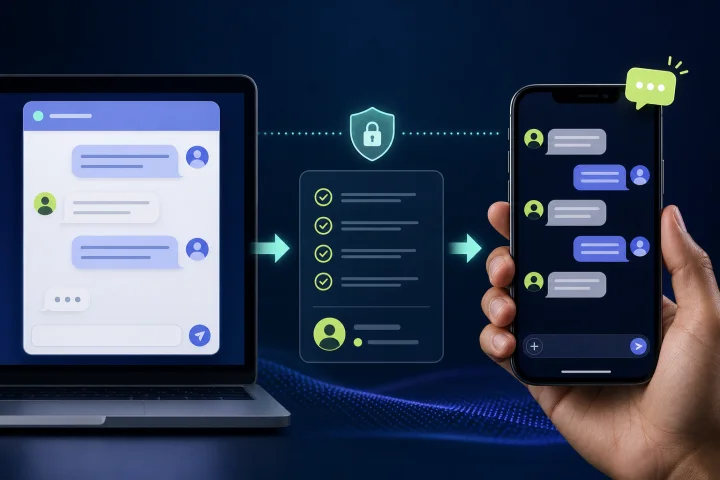
Why a channel switch needs operational controls
Changing channel can make support easier for a customer, but it can also create avoidable risk. The customer may have chosen WebChat because it is convenient on a shared device, while a team may prefer WhatsApp because it is faster to manage. Convenience for the team is not, by itself, a reason to disclose account information through a different destination.
The four recurring failures are unclear permission to contact a customer on the new channel, lost context that forces the customer to repeat themselves, duplicate work caused by two live threads, and disclosure before the person is appropriately verified. Treat the move as a controlled case handoff, not as an informal invitation to start again elsewhere.
Where the GDPR applies, [purpose limitation and data minimisation](https://eur-lex.europa.eu/legal-content/EN/TXT/?qid=1772981449498&uri=CELEX:32016R0679) support transferring only what is needed to resolve the case. Logs should also allow an investigation of who moved the case, when, from where, to which destination, and why. [OWASP logging guidance](https://cornucopia.owasp.org/taxonomy/asvs-5.0/16-security-logging-and-error-handling/02-general-logging) says logs need sufficient event metadata and that sensitive data must be handled according to its protection level. Do not put credentials, payment details or unmasked session tokens into handoff notes or operational logs.
- Use the original thread as the source of truth until the handoff is accepted.
- Copy a concise case summary, not an unrestricted transcript by default.
- Record the reason for the move, customer response, destination channel, operator, timestamp and verification status.
- Apply the same accessibility care to the channel-switch notice as to every other customer-facing message: it should be clear, readable and workable with assistive technology. [WCAG](https://www.w3.org/WAI/standards-guidelines/wcag/) applies to dynamic and mobile web content.

Separate a customer-requested move from team-initiated outreach
Start by identifying who asked to move. A customer who says, “Please continue on WhatsApp,” has requested a service-channel change. Confirm the destination and explain the next step, but do not assume that a request made in one case creates permanent permission for future contact on that channel.
A team-initiated message is different. If an operator wants to leave WebChat and message the customer elsewhere, the team must establish whether it may use that destination for this purpose. This is particularly important for WhatsApp: its [Business Messaging Policy](https://business.whatsapp.com/policy/preview?lang=id_ID) says a business may contact a person there only after the person has provided their mobile number and opted in to receive subsequent messages from that business on WhatsApp. Provider policy is separate from applicable privacy and electronic-communications rules.
Do not disguise promotional outreach as a service handoff. In the United States, the [FTC notes](https://www.ftc.gov/business-guidance/resources/can-spam-act-compliance-guide-business?%2523038=&%252523038=) that a mixed service-and-promotional email is judged by its primary purpose; an existing customer relationship does not automatically make it transactional. Keep a service handoff focused on resolving the open case, and route any marketing question to the appropriate compliance process.
- Customer-requested: confirm the requested channel and capture the request in the case record.
- Team-initiated: offer a genuine choice and check documented, channel-specific permission before sending a message.
- Marketing or mixed-purpose content: stop and seek review from the responsible privacy, compliance or legal function.
- No recorded permission or uncertainty: continue in the existing channel or offer a customer-controlled alternative.

Run a four-part channel-switch decision test
Before moving a case, the operator or automation should answer four questions. First, what is the specific purpose? Examples include continuing a customer-requested conversation, sending a file through an available channel, or completing a verified recovery process. “It is easier for us” is not a sufficient standalone purpose.
Second, is the move necessary? If the original WebChat remains available and can resolve the issue safely, staying there may be the lower-risk choice. Third, does the customer have a meaningful choice? The customer must be able to remain in the current channel, choose another supported route, or pause. A refusal must not result in poorer service without a genuine operational reason.
Fourth, is there a safer alternative? For example, provide general troubleshooting in the current thread rather than moving account-specific discussion to an unverified number. If the case involves account recovery, suspected fraud, sensitive personal information, payment information or an identity mismatch, use the documented high-risk workflow and involve a human specialist.
- Purpose: Can the operator state the case-specific reason in one sentence?
- Necessity: Can the issue be resolved safely in the current channel?
- Choice: Has the customer been offered an unpressured option to stay?
- Safety: Does the proposed destination and verification state fit the sensitivity of the discussion?
- Escalation: If any answer is unclear, pause the move and assign the case to a supervisor, privacy lead, security team or designated account-recovery team under internal procedure.
Ask clearly and explain the boundaries of the move
A good offer is short, specific and neutral. It says why a different channel could help, identifies the channel, makes staying put acceptable, and avoids claiming that the new channel is inherently more secure. Do not pressure the customer with false urgency or imply that they will lose support if they decline.
Use this pattern: “We can continue this support case on WhatsApp if you prefer. We would use it only to help with this open case. You can stay in this chat instead. If you want to move, please confirm the number or use our approved connection option. Please do not send passwords, full payment-card details, one-time codes, or other secrets here.”
Tell the customer what will transfer: a short description of the issue, steps already taken, the open question, and the assigned team. Also explain what will not transfer automatically, such as authentication status where re-verification is needed, files that are not necessary, or unrelated historic conversations. This prevents assumptions that can lead to unsafe disclosure.
- State the purpose and the named destination channel.
- Offer an equal, usable option to continue in the current channel.
- Describe the minimum case context that will be carried over.
- Tell the customer not to send secrets, payment-card details or authentication codes.
- Explain whether they must complete verification again before account-specific discussion continues.
Create a minimum handoff record that prevents repetition
The receiving operator should be able to continue the case without asking the customer to repeat the basic story. Create a structured handoff record before the original thread is set to waiting or closed. Keep it brief enough to be useful and limited enough to avoid unnecessary copying of personal data.
A minimum record supports continuity, accountability and reporting. It should be attached to the case or shared conversation record, not placed in an uncontrolled side channel. The record is not a substitute for reading relevant prior messages when necessary, nor is it permission to reveal account-specific information before verification is complete.
- Case summary: the customer’s stated issue and the requested outcome.
- Actions taken: troubleshooting, guidance, documents requested, and any commitments already made.
- Open question: the next decision, missing information or pending action.
- Owner and department: one named accountable operator or queue.
- Priority and service level: the operational urgency and applicable target.
- Verification status: unverified, verified for a stated scope, failed, expired or requires re-check.
- Channel-move record: origin, destination, purpose, customer request or choice, time, operator and original-thread status.
- Safety flags: suspected fraud, vulnerable-customer need, accessibility accommodation, complaint, or sensitive-data restriction.
Verify identity again when the risk or destination requires it
A conversation history is not automatically proof that the person now using a different channel is the same authorized person. The verification requirement should be driven by the sensitivity of the next action, the assurance achieved in the original interaction, the change in destination, and the organization’s documented risk analysis.
For a newly supplied recovery destination, [NIST guidance](https://pages.nist.gov/800-63-4/sp800-63b.html) requires verification through a confirmation code before the address is established. More broadly, NIST states that alternative recovery methods, including agent interaction, should be based on and documented through risk analysis. Repeated identity proofing should be consistent with the assurance level used to establish the account and confirm the claimant against the existing account.
Until verification is sufficient for the action, keep the discussion general. Explain process, available options and safe next steps, but do not disclose account balances, order history, personal profile details, recovery information or other protected case content. Never ask the customer to send a password, one-time passcode or full payment-card details in a chat.
- Low sensitivity: general product guidance may continue without account disclosure.
- Account-specific support: follow the organization’s verification standard before discussing protected details.
- New or changed destination: treat it as unverified until the prescribed confirmation succeeds.
- Recovery, fraud or mismatch: stop normal handling and transfer to the designated human security or recovery team.
- Verification failure: explain the safe alternative, document only necessary facts and do not reveal why an account may exist or what it contains.
Keep one owner and close the original thread deliberately
A channel switch often produces duplicate replies because the original chat remains routed to one operator while the new conversation enters another queue. Assign one case owner at the time of handoff. Departments and routing rules can help direct work, but accountability must still be visible to the team.
Set the original thread to a defined status such as “moved—awaiting customer,” “moved—active on destination,” or “closed after successful handoff.” Add the destination reference in the case record rather than relying on memory. Do not report the old thread as resolved merely because an outbound message was sent; it may still require a response or a failed-handoff follow-up.
If the customer returns to the original WebChat, resume there unless there is a documented reason not to. Update the owner and status immediately, and stop duplicate outbound messages. If the customer does not respond on the proposed destination, use the pre-defined timeout and return path; do not repeatedly contact them simply because the team prefers the new channel.
- Assign one accountable owner before sending or accepting the handoff.
- Mark the origin thread with a specific handoff status and the next review time.
- Suppress parallel replies from other queues or automations.
- Reopen or resume the original channel when the customer returns there.
- Measure handoff completion separately from case resolution to avoid misleading service-level reporting.
Record channel preferences as scoped, changeable evidence
A channel preference is not permanent permission. Record what the customer chose, for which channel, for what purpose, when it was recorded and how it was obtained. Where consent is the relevant basis, people must be able to withdraw it, and withdrawal does not undo processing already performed before withdrawal. [GDPR Articles 7 and 13](https://eur-lex.europa.eu/legal-content/EN/TXT/?qid=1772981449498&uri=CELEX:32016R0679) set out these consent and information requirements where the GDPR applies.
For electronic marketing, [UK ICO guidance](https://ico.org.uk/for-organisations/direct-marketing-and-privacy-and-electronic-communications/guidance-on-direct-marketing-using-electronic-mail/how-do-we-comply-with-the-pecr-electronic-mail-marketing-rules/?search=charity) emphasizes that consent is specific to the channel and address. That principle is a useful operational safeguard even when handling service conversations: do not treat a preference or opt-in on one address or channel as a blanket authorization for another. Keep service handoff records distinct from marketing-consent records.
Where the GDPR applies, a privacy notice should describe the processing purposes, legal basis, and retention period or the criteria used to determine it. [Records of processing and other internal documentation](https://ico.org.uk/for-organisations/advice-and-services/audits/data-protection-audit-framework/toolkits/accountability/records-of-processing-and-lawful-basis/) should document items such as recipients, transfers, retention schedules, technical and organisational security measures, data locations, and relevant consent records. Escalate any uncertainty about legal basis, consent scope, retention or cross-border handling to the responsible privacy or legal function.
- Record: customer, channel or destination, purpose, affirmative action or request, date and time, and source record.
- Do not infer consent from silence, inactivity or a lack of objection. [ICO guidance](https://ico.org.uk/for-organisations/direct-marketing-and-privacy-and-electronic-communications/guidance-on-direct-marketing-using-electronic-mail/how-do-we-comply-with-the-pecr-electronic-mail-marketing-rules/?search=charity) states that silence and inactivity do not demonstrate marketing consent.
- Do not reuse a one-case request as permission for future unrelated outreach.
- Honor a refusal or withdrawal promptly within the scope stated by the customer and applicable procedure.
- Review retention and access controls for conversation exports and handoff logs.
Frequently asked questions
Can a support agent move a customer from WebChat to WhatsApp because the team prefers WhatsApp?
Not as a default. First assess the case purpose, whether the move is necessary, whether the customer has a real choice to stay in WebChat, and whether the business may contact that person on WhatsApp. The [WhatsApp Business Messaging Policy](https://business.whatsapp.com/policy/preview?lang=id_ID) requires the person to provide their number and opt in to subsequent messages from that business on WhatsApp.
What information should transfer with a support channel handoff?
Transfer only the information needed to continue the case: a concise issue summary, actions taken, the open question, owner, priority, verification status and relevant safety flags. Avoid copying secrets, payment information, unnecessary personal data or unrelated conversation history.
Does identity verification carry over to a new channel?
Not automatically. Decide using the sensitivity of the next action, the prior assurance level, the new destination and the organization’s risk-based procedure. Keep discussion general until verification is sufficient for account-specific disclosure or action. [NIST guidance](https://pages.nist.gov/800-63-4/sp800-63b.html) requires confirmation before a newly supplied recovery destination is established.
What should happen if the customer does not respond on the new channel?
Follow a documented timeout and return path. Keep one case owner, preserve the original conversation record, and avoid repeated outreach merely for team convenience. If the customer returns to the original channel, resume there and update the case status.
How can webchat.vip support controlled handoffs?
webchat.vip provides a shared inbox for WebChat and WhatsApp conversations, with operators, departments, routing, schedules, service levels, templates and tags. Teams can use shared records and controlled routing to maintain ownership, use templates for clear channel-switch messages, and review conversation logs and exportable reports. Verification policy, consent decisions and escalation criteria remain the organization’s responsibility.
Sources and further reading
Primary and authoritative references used to verify the factual foundation of this guide.
- General Data Protection Regulation (Regulation (EU) 2016/679) — EUR-Lex / European Union
- Guidance on direct marketing using electronic mail — UK Information Commissioner's Office
- CAN-SPAM Act: A Compliance Guide for Business — Federal Trade Commission
- NIST SP 800-63B-4: Digital Identity Guidelines — Authentication and Authenticator Management — National Institute of Standards and Technology
- OWASP ASVS 5.0 — General Logging — OWASP Foundation
- Records of processing and lawful basis — UK Information Commissioner's Office
- WCAG 2 Overview — W3C Web Accessibility Initiative
- WhatsApp Business Messaging Policy — WhatsApp Business / Meta