
Customer Support Inbox Capacity Planning for WebChat and WhatsApp
A practical routine for forecasting demand, setting safe staffing assumptions, monitoring queue pressure and protecting quality in shared WebChat and WhatsApp inboxes.
Read guideClear, evidence-based guidance for teams building useful omnichannel service without losing context, control or the human touch.
A practical routine for forecasting demand, setting safe staffing assumptions, monitoring queue pressure and protecting quality in shared WebChat and WhatsApp inboxes.
Read guide
Build a risk-based support priority model that protects customers, gives teams clear routing rules and keeps service-level reporting credible.
Read guide
A practical framework for keeping messaging channels open outside staffed hours without implying immediate human support, losing urgent cases, or creating an unmanaged next-shift backlog.
Read guide
A routing-rule register turns inbox settings into a reviewable operational policy. Use it to define triggers, precedence, ownership, schedules, fallbacks and tests before messages become stranded in hidden queues.
Read guide
Concurrent support work is a workload-and-ownership design problem. Set clear owners, priorities, handoffs and capacity controls before context and quality deteriorate.
Read guide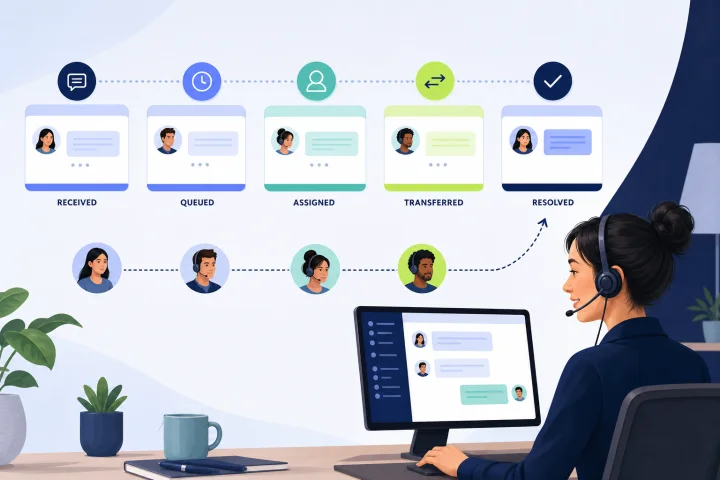
Waiting, queue and transfer messages are operational commitments, not filler copy. Learn how to define service states, set credible timing and keep a clear route to human help.
Read guide
A practical policy for sending useful, customer-visible updates while an issue remains unresolved, with cadence tiers, ownership rules, templates and escalation controls.
Read guide
Build a practical policy for aging customer conversations, escalating stalled work and reassigning ownership without forcing customers to repeat themselves.
Read guide
A practical framework for treating customer silence carefully, routing stalled chats correctly, and making closure messages clear, reversible and accountable.
Read guide