How to Define Customer Support Closing Reasons That Improve Reporting
A practical policy for defining closing reasons that describe why work ended without confusing closure with resolution, satisfaction or lasting customer success.
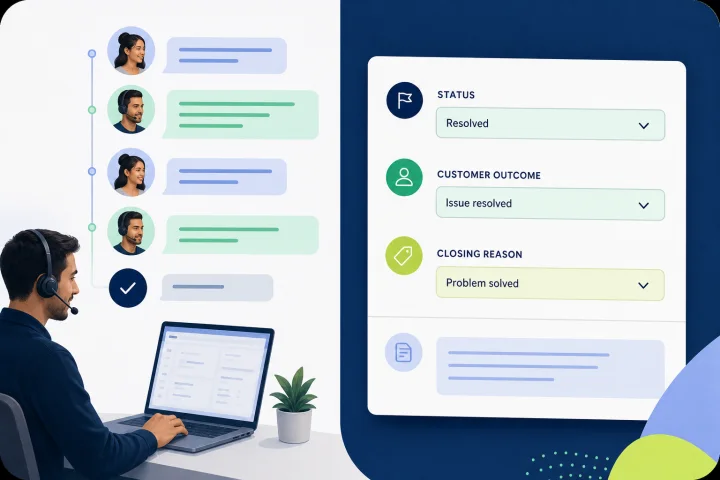
Closed is a workflow state, not a service-quality verdict
A conversation status tells the team where an item sits in the workflow. A customer outcome describes what is known to have happened for the customer. A closing reason records why the team stopped active work on that conversation at that time. These are related facts, but they should not be treated as interchangeable.
The distinction matters because a closed conversation may represent a confirmed answer, a duplicate thread, a customer who stopped replying, a handoff to another process, or work awaiting an external party. None of those cases alone proves that the customer’s underlying issue was resolved or that they were satisfied.
This separation is consistent with the way mature support processes distinguish resolution, analysis, auditing and effectiveness review. It also improves data quality: a useful field is fit for its planned use and is accurate, complete, consistent and timely.
Some systems make the distinction explicit. For example, Zendesk defines Solved as an agent submitting a solution, while Closed is a system-closed state that the requester cannot reopen. Your own labels and mechanics may differ, but the governance principle remains: do not report a workflow transition as proof of an outcome.
- Status: open, assigned, pending, on hold or closed, depending on the team’s workflow.
- Outcome: confirmed resolved, information provided, workaround offered, unresolved, unknown or another deliberately defined state.
- Closing reason: duplicate conversation, no customer response, transferred to another team, external dependency, customer request, or another observable reason active work ended.
- Customer rating: separate feedback data, not a substitute for an outcome or closing reason.

Start with the decisions the data must support
Do not begin by brainstorming labels. Begin with the decisions a manager, quality analyst or team lead must make. A closing-reason taxonomy is operational data quality: it should help people identify demand, manage work that may return, test whether routing works and find cases that need review.
For every proposed reason, write the decision it will support. If no one can name a decision, report, queue rule, quality question or follow-up action, remove the label or capture the information elsewhere.
In a shared WebChat and WhatsApp inbox, review reasons by channel, department, routing path, schedule and service-level context where those dimensions are available. webchat.vip provides a shared inbox for WebChat and WhatsApp, operator and department organization, routing, schedules, service levels, tags, conversation logs, ratings and exportable operational reports. Those records can support review; they do not turn a closing reason into proof of resolution.
- Demand patterns: Which customer needs repeatedly end as an external dependency or a transfer?
- Backlog risk: How many conversations were closed because the customer did not respond, and how many later return?
- Quality checks: Are operators choosing the reason that the transcript supports?
- Routing improvement: Are specific departments receiving avoidable transfers or duplicate contacts?
- Follow-up risk: Which closure reasons should be monitored for a return contact, complaint or manual outreach under your policy?

Use a small, observable and actionable taxonomy
A usable taxonomy has categories that operators can recognize from the conversation record, select consistently and explain to a reviewer. It should be mutually distinct enough that two trained operators normally choose the same label for the same case. It must also be small enough to use under normal workload.
Avoid labels based on assumptions about intent or emotion unless the customer has made the point explicit and the label serves a defined process. “Customer unhappy,” “not a real issue” and “agent error” are poor default closing reasons: they are vague, potentially unfair and often mix different operational questions.
Test each label against four checks: can it be observed, is it distinct, does it cause an action or inform a decision, and can an auditor verify it from the transcript or linked record? If the answer is no, rewrite, merge or remove it.
- Keep required closing reasons to roughly the smallest set that answers the team’s core questions; add detail only when it changes a decision.
- Use plain-language definitions, inclusion rules, exclusion rules and one positive example for every label.
- Use “unknown” only when it is genuinely necessary, and audit it. It should reveal a limitation in evidence, not become a convenient default.
- Version the taxonomy. Preserve a mapping when labels are renamed or merged so trend reporting remains interpretable.
A starter structure: need, action, outcome and closure
One field rarely carries every fact needed for useful reporting. Instead of creating a long list of hybrid labels such as “billing question solved after transfer,” separate the dimensions where your tools and workflow permit. This reduces ambiguity and makes analysis more flexible.
Use a required closing reason for why active work ended. Capture customer need, action taken and current outcome in separate structured fields only if the team has a clear use for them. Where a platform does not support separate fields, use a concise standardized entry in the conversation record and document its reporting limitations.
Tags are useful for flexible, cross-cutting markers such as a campaign, product area or incident reference. They should not silently become a second, competing closing-reason system. Keep the authoritative closing reason in one governed location.
- Customer need: account access, billing, order status, technical issue, product information, complaint or another demand category.
- Action taken: answer provided, troubleshooting performed, transferred, refund process initiated, self-service resource shared or escalation opened.
- Current outcome: confirmed resolved, customer indicated resolution, pending external action, unresolved, unknown or not applicable.
- Closing reason: why the operator or workflow ended active handling of this specific conversation.
Define ambiguous cases before operators encounter them
Ambiguous cases are where reporting drift begins. Give staff a decision rule that starts with evidence in the transcript, not with the fastest available label. When evidence is incomplete, record what is known and use the defined unknown or no-response path rather than implying success.
A transfer or escalation is not itself a resolution. It should preserve ownership, receiving team and the next required action. If the originating conversation is ended after a handoff, its closing reason can describe the handoff, while the receiving process records its own eventual outcome.
External dependencies deserve special care. Closing an inbox thread because the team is waiting for a carrier, payment provider, engineering investigation or another outside party can hide unfinished work. Keep the work open, on hold or in a tracked follow-up process when your policy requires action. If a conversation must close, make the dependency visible in the closing reason and linked record.
- Duplicate conversation: select only when the same customer issue is already actively handled elsewhere. Link or identify the primary record according to your privacy policy; do not mark a separate issue as duplicate merely because the customer has contacted you before.
- Customer abandonment: use only when the customer explicitly leaves or when your policy defines the situation. Do not infer abandonment from a short pause.
- No-response closure: select when the team requested information or offered help, the documented wait period elapsed and no reply arrived. This means outcome unknown unless other evidence exists.
- External dependency: use when a needed next step belongs to a third party or a separate internal process. Record the owner and next review point in the appropriate tracked workflow.
- Escalation or transfer: use when responsibility moved. Record the destination, reason for handoff and whether the receiving party accepted it.
- Customer-requested closure: use when the customer clearly asks to end the conversation; it does not prove that their need was met.
Assign ownership and capture the reason at the right moment
The operator ending active work should normally select the closing reason because they have the freshest context. A receiving owner should select or amend it when the work was transferred and they complete the final handling. Supervisors and quality analysts may correct a reason after review, but corrections should be attributable and should not erase the learning opportunity.
Capture the reason at the closure event or immediately before it. Delayed completion increases guesswork. If automation can close conversations, identify its closure paths separately and test whether required fields are bypassed. Some inbox products explicitly note that required-before-close controls may not apply to automated, workflow or API closure; teams should verify the behavior of their own configuration rather than assume enforcement.
webchat.vip automated flows can send messages and files, collect validated responses, branch, transfer and hand off to people. Use automation to collect clear inputs and route work, but send exceptions, complaints, ambiguity, safety concerns and requests requiring judgment to a person. Automation should not infer that silence equals resolution.
- Operator: selects the provisional or final reason supported by the transcript.
- Receiving team: confirms the eventual handling reason after a transfer, when it owns completion.
- Team lead: resolves disputes, approves exceptions and monitors missing or overused labels.
- Quality analyst: audits accuracy and recommends taxonomy or training changes.
- Administrator: controls allowed values, workflow prompts, reporting mappings and documented change history.
Audit accuracy, completeness and change over time
A taxonomy is a living operational control, not a one-time configuration. Run a regular quality review using a sample across operators, departments, channels, high-volume reasons and high-risk reasons. Compare the selected value with the transcript and any linked follow-up record. Score whether the reason is supported, whether required context exists and whether the correct escalation path was used.
Measure both selection quality and taxonomy health. A high rate of “other,” “unknown,” “resolved” or no-response closure can signal unclear definitions, inadequate workflow design, a training gap or a change in customer demand. Do not assume it is an operator-performance problem without reviewing evidence.
Document proposed changes, their rationale, effective date, owner and report mapping. Pilot major revisions with a small group, then teach the changed rules with examples and short calibration exercises. ISO 10002 identifies training, analysis, auditing and review as separate elements of effective complaints handling; treat closing-reason governance with the same discipline.
- Weekly or monthly: audit a risk-based sample of closed conversations.
- For every audited item: compare transcript, selected reason, outcome, transfer history and any subsequent contact.
- Calibrate: have two reviewers classify a small shared sample, discuss disagreements and refine definitions.
- Track: missing values, correction rate, “other” rate, reviewer disagreement and reopen or repeat-contact patterns by reason.
- Change safely: maintain a taxonomy version log and map old values to new reporting groups.
Frequently asked questions
What is the difference between a customer support closing reason and a resolution code?
A closing reason states why active handling of a conversation ended. A resolution code or outcome states what is known about the customer’s issue. They can match in a simple case, but a no-response closure or external dependency shows why they should remain separate.
Should every closed conversation be reported as resolved?
No. Closed is a workflow status. Report confirmed resolution, unknown outcome, transfers, no-response closures and external dependencies separately so leaders do not mistake closure volume for service quality.
How many customer support closing reasons should we use?
Use the smallest set that supports defined decisions and can be applied consistently. Start with a limited core set, audit real conversations and add a category only when it is observable, distinct and actionable.
What should happen when a customer stops replying?
Use a documented no-response process: state what information or action was requested, wait for the approved period, send any required reminder, then close with a no-response reason. Record the outcome as unknown unless the transcript provides evidence otherwise.
Who can change a closing reason after a conversation is closed?
Allow a defined supervisory or quality-review role to correct clear errors, and keep a record of the correction and rationale. The correction process should improve reporting without hiding the original training or workflow issue.
When should a human take over from automation?
Hand off to a person when the case is ambiguous, involves a complaint, requires a judgment call, includes sensitive circumstances, has an unresolved external dependency, or needs an exception to the normal closure policy.
Sources and further reading
Primary and authoritative references used to verify the factual foundation of this guide.
- ISO 10002:2018 — Quality management: Customer satisfaction — Guidelines for complaints handling in organizations — International Organization for Standardization (ISO)
- Research Data Framework (RDaF): Version 1.5 — National Institute of Standards and Technology (NIST)
- About the ticket lifecycle and ticket statuses — Zendesk Help
- How and when to use conversation topics, attributes, and tags — Intercom Help
- Create and use conversation data attributes (CvDAs) in the Inbox — Intercom Help
- Reporting metrics & attributes — Intercom Help
- Loop teammates or teams into conversations — Intercom Help
- Assign conversations to teammates and teams — Intercom Help